
Jeonju, South Korea
Jan 11, 2024
Jeonju, South Korea
Our next stop, traveling north by train
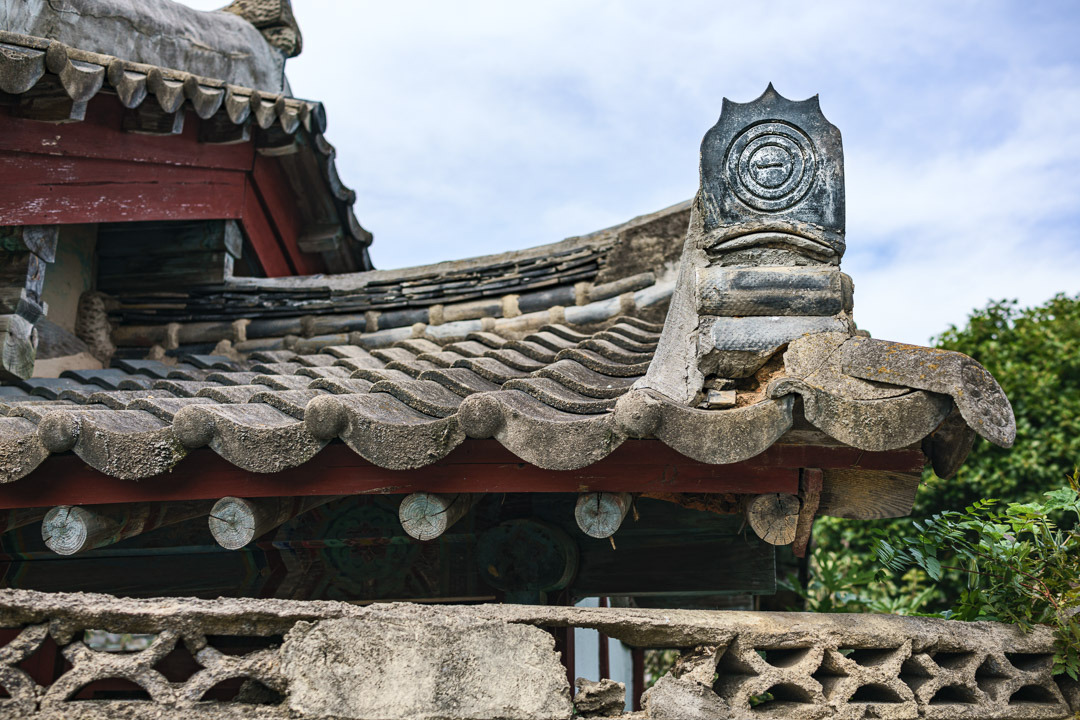
The finishing touch on a very old roof
A tire shop, an alleyway, and an Airbnb. When you can't rent a car and rely on mass transit, things happen that otherwise couldn't be.
If you remember, we couldn't rent a car because my international driver's license had expired. A rookie move, I admit. Stuff happens, and it may not seem ideal at the time, but you gotta roll with it. Otherwise, it's miserable, and the handwringing over how it should have been is a total buzz kill.
The express train took us to the center of Jeonju, which is on the west coast of South Korea. We took an Uber to our Airbnb, which was in an older part of town. Now, the thing about Airbnb is that you don't know where your rental is located until the day you check in. When the Uber driver pulled up and stopped by a tire shop, it gave us pause. When he directed us down an alleyway, we became concerned.
The Airbnb host showed up right away and led us upstairs to the apartment. I can't tell you how charming this place was. Our host had recently finished renovations, and the rooms sparkled. You couldn't even tell there was a tire shop next door. I didn't get the full story behind how she came to own the property. It was something about her and her husband not talking for years but also not getting a divorce. She needed an income and had the means to buy this dilapidated building to fix up and rent out. So that's what she did.
My wife, daughter, and I were hanging out in the apartment, figuring out where to explore the town of Jeonju. A knock at the door; it was our host. As it turned out, she had the following day free and would like to take us around to see the sights in her town. I guess she felt sorry for us since we didn't have a car. It seems, in this case, it worked in our favor.
We piled into her car the following day and headed out. Our first stop was a remarkable little cluster of homes on the edge of a lake. A village, in fact. We walked through the neighborhood and stepped back in time. The houses were old. Some could have been hundreds of years old. It was quaint, with vegetable gardens and fruit trees dotting the yards. And chickens roaming here and there.
This is a part of Korea that is disappearing. Being replaced by high-rise apartments and freeways. The small villages, with subsistence farming and a close community, are being forced out. The need for land in this sea-locked country is too great.
The tile roofs on the buildings in this tiny community were fascinating. These days, almost anywhere you look in Korea, the roofs look traditional but are made of tin or plastic. Honestly, it seems kinda cheap when you look up close. And so, the roofs in this village are what I photographed. They are solid and old-school. The wood trusses holding them up seemed the same - solid and old school. There is a reason we love the old stuff. If it's still around, it was well made.
At the top. The corner piece on the roof of a house we walked past. The details in these old roofs are marvelous. The tile is called Giwa in Korean and is usually made of clay or cement mixed with sand. This roof looks like the cement version.
Below, top. A view of the mountains over the top of a home in this tiny village. I almost didn't include this photo here. Still, there is something that gets me about this scene. Maybe it's how nature intermixes with the house as the vines cross the roof.
Finally, at the bottom. The underpinnings of a pagoda roof show off colorful paintings which have faded with age. The pagoda is open all around and exposed to the elements. It's a wonder the paint survives at all.
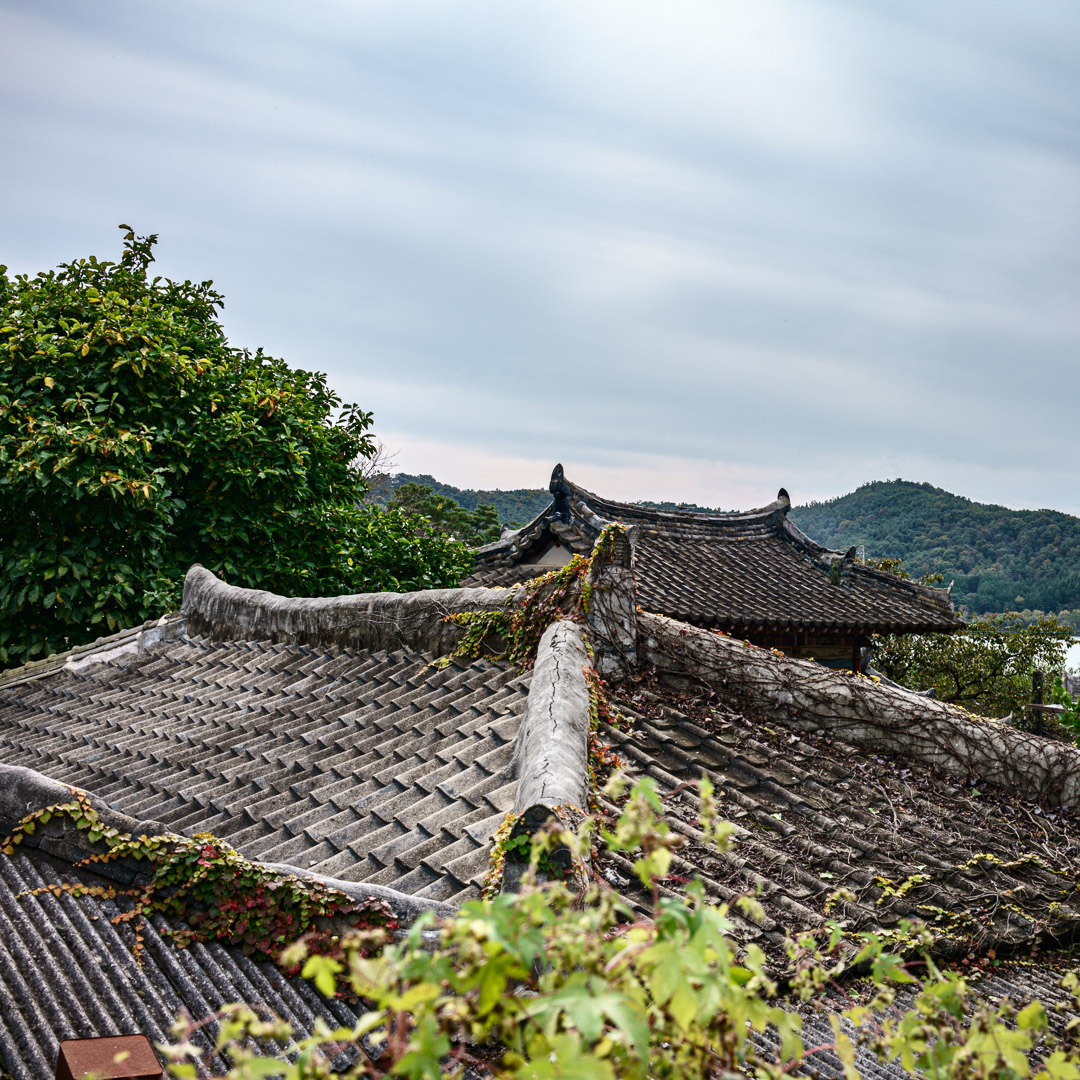
Looking out toward the mountain over the rooftops.
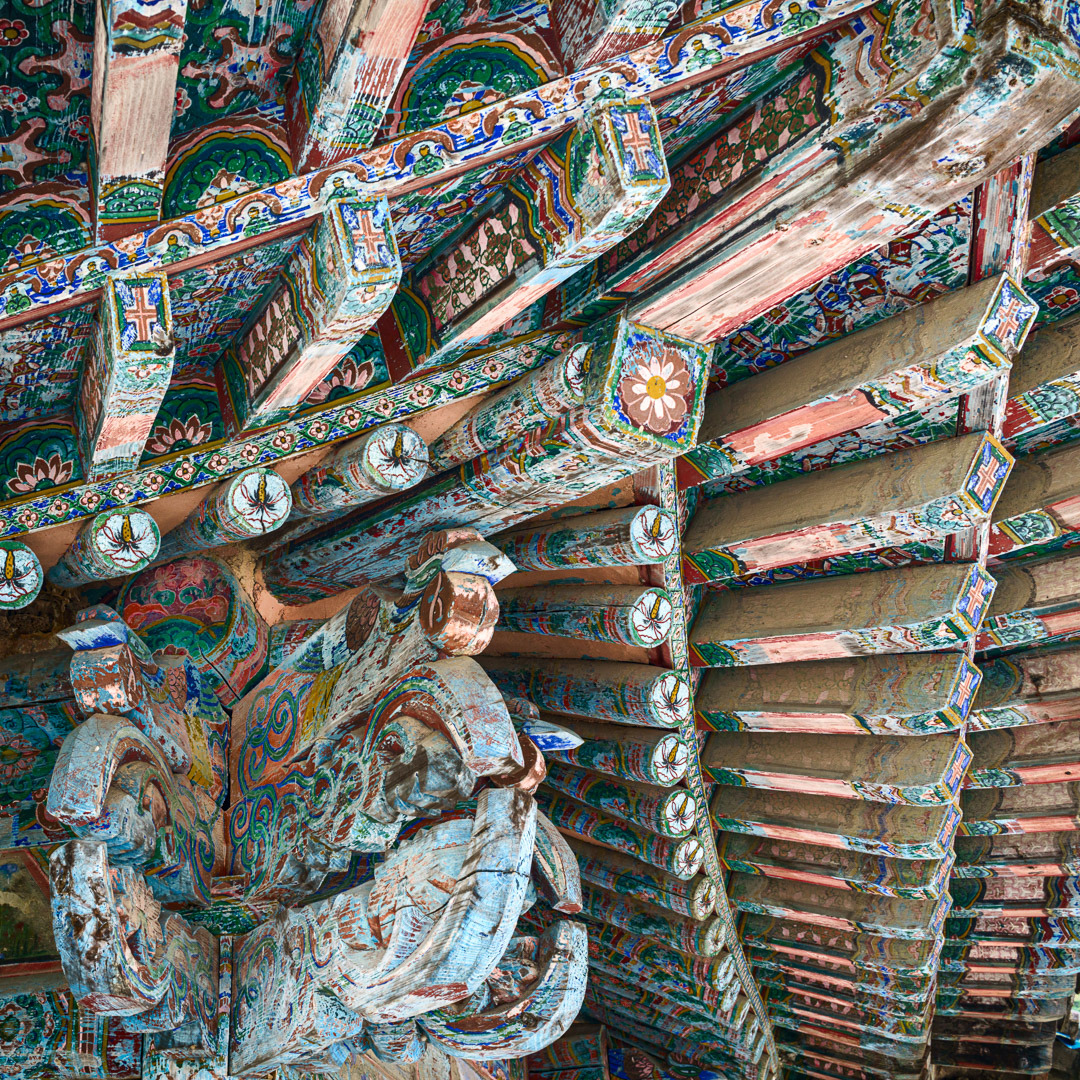
This intricate work supports the roof of a small pagoda in the center of the village.